
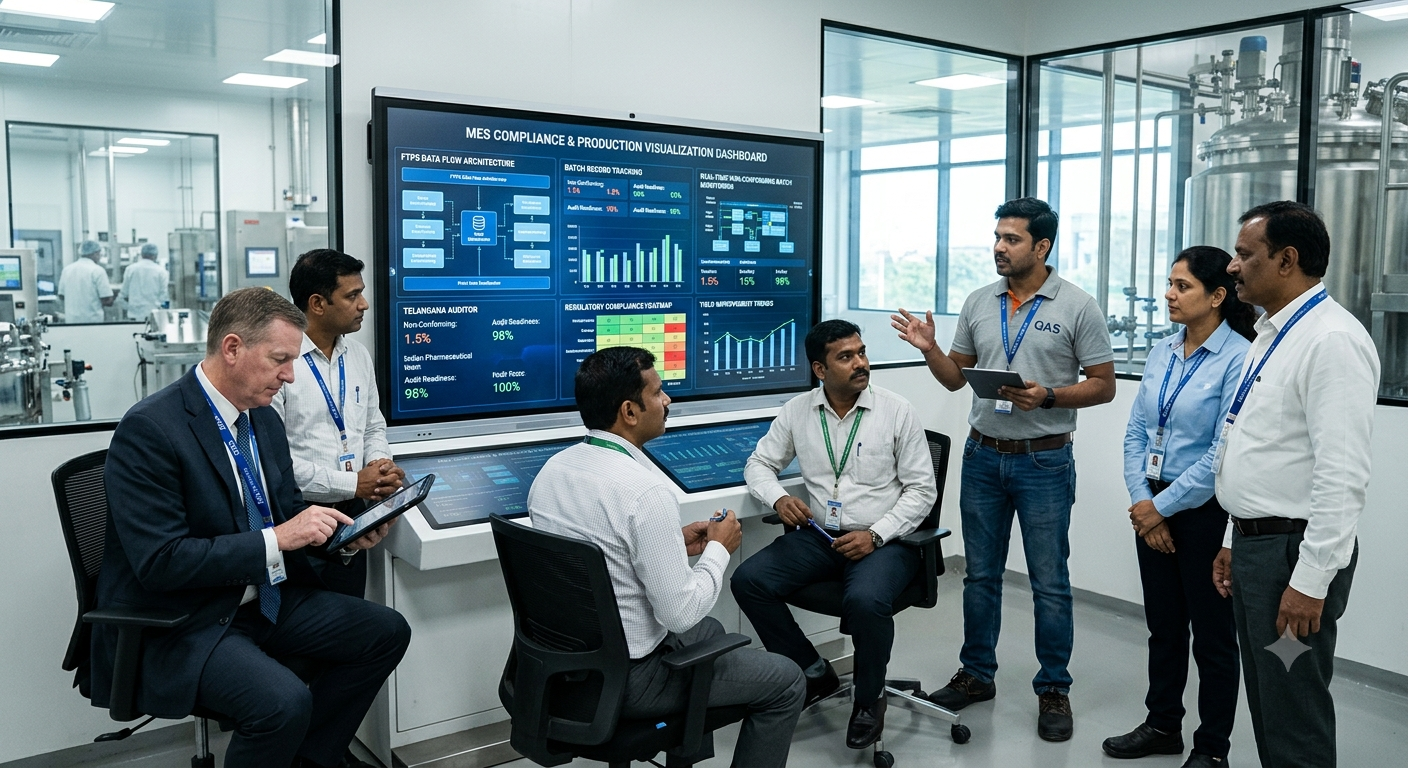
Leading Life Science Manufacturer — MES with FTPS-Driven Regulatory Compliance
MES solutions with FTPS functionalities delivering regulatory compliance, traceability, and reduced non-conforming production for the life sciences industry
Published July 8, 2026
Challenge
Regulatory Complexity Demanding Digitized, Auditable Systems
Life science manufacturing operates under some of the strictest regulatory requirements of any industry — where digitizing the system isn't optional but necessary to reduce the cost of rapidly changing regulatory requirements and maintain audit-ready compliance at every stage of production.
Manual Processes Driving Labor Costs and Rework Risk
Without an MES, labor needs remained high due to manual data entries, long batch record review cycles, and the ongoing need to rework nonconforming materials — all of which added cost and risk in an industry where a single compliance gap can halt production entirely.
Non-Conforming Materials Threatening Cost and Safety
Materials conformance issues directly affected product variability and safety profile, increasing the risk of recalls and the number of nonconforming batches — each one costing the client both time and money, and each one a potential regulatory exposure.
Waste and Production Capacity Constraints
Waste disposal from non-conforming production materials, combined with limited production capacity around cycle times and yields, meant the client needed a system capable of improving throughput while simultaneously reducing waste — two goals that are difficult to achieve without real-time process visibility.
Solution
An MES Built Around FTPS Functionalities for Regulatory-Grade Manufacturing
QAS leveraged its manufacturing and technology expertise to deliver MES solutions with FTPS (Rockwell) functionalities specifically suited to the life sciences industry's MES implementation needs — addressing waste disposal, labor needs, production capacity, materials conformance, resource efficiencies, and regulatory requirements as a connected system rather than isolated problems.
Reducing Labor Needs Through Automated Data Capture
The MES reduces human resource needs by eliminating manual data entries, reducing the time required to review batch records, and eliminating the need to rework nonconforming materials — directly cutting both labor cost and compliance risk in a single system.
Improving Production Capacity and Materials Conformance
By improving cycle times and yields while eliminating nonconforming product, the MES directly improved production capacity — while simultaneously reducing product variability, improving safety profile to avoid recalls, and reducing the number of nonconforming batches to save time and cost.
Built on a Proven FTPS, JAVA, and SQL Technology Stack
The implementation was built using FTPS (Rockwell), JAVA, and SQL — a focused technology stack aligned with the regulatory and data-integrity demands of life science manufacturing environments.
A Lean, Fully Offshore Delivery Team
A team of 2 to 3 QAS engineers delivered this MES solution through a fully offshore delivery model over a 1+ year engagement, demonstrating that regulatory-grade MES capability can be delivered efficiently without requiring a large onsite presence.
Result
From Manual Compliance Burden to Digitized Regulatory Readiness
The MES deployment gave this life science manufacturer regulatory compliance and traceability built directly into daily operations — reducing the cost and effort of adapting to rapidly changing regulatory requirements that previously demanded constant manual oversight.
Measurable Gains in Quality and Data Integrity
With quality control and assurance, real-time monitoring and data integrity, and advanced automation and process optimization now in place, the client reduced nonconforming batches, improved yield, and strengthened the safety profile of its production output.
Stronger Supply Chain and Research Capabilities
Supply chain and cold chain management, combined with precision manufacturing and laboratory management, gave the client tighter control over sensitive materials — while machine learning in research and drug discovery and support for clinical trials and therapeutic advancements positioned the MES as infrastructure for innovation, not just production.
A Proven Regulatory-Grade MES Model for Life Sciences
This engagement demonstrates QAS's capability to deliver FTPS-based, regulatory-compliant MES solutions for the life science and pharmaceutical manufacturing sector — proving that Industry 4.0 smart manufacturing principles can be applied even in the most heavily regulated production environments.
Project Details
Want similar results?
Let's discuss how we can transform your manufacturing operations.
Talk to Our Experts